Single vs Double Universal Joint – Selection Guide for High Angle, High Torque Applications
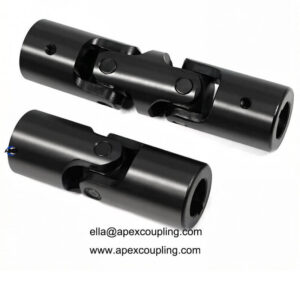
Universal joints (cardan joints) are essential for transmitting power between non‑collinear shafts. But choosing between a single joint and a double joint – and selecting the right bearing type – can be confusing. This guide explains everything using the WX/WXD series (42CrMo steel, H7 bore) as a practical example.
1. Single Joint (WX) vs Double Joint (WXD)
| Feature | Single Joint (WX) | Double Joint (WXD) |
|---|---|---|
| Angular misalignment | ✅ Up to 45° | ✅ Up to 45° per joint |
| Parallel offset | ❌ No | ✅ Yes (via two joints) |
| Output speed fluctuation | Present (sinusoidal) | Greatly reduced (near constant) |
| Length | Short | Longer |
| Torque capacity | Same as double for same size | Same as single |
| Best for | Shafts intersect at a point | Shafts offset + angled |
| Typical applications | Steering linkages, single‑plane angle | Long spans, conveyors, machinery with parallel offset |
Rule of thumb:
Use single joint (WX) when the two shafts are on the same plane but angled (e.g., steering column).
Use double joint (WXD) when the shafts are both angled and offset (e.g., conveyor drive with a lateral shift).
2. Angular Capacity – Up to 45° Per Joint
The WX/WXD series allows up to 45° limit angle per joint. For continuous operation, we recommend ≤40° to ensure long bearing life.
⚠️ Operating at the absolute maximum angle (45°) increases wear. If your application requires constant high angle, consider a constant‑velocity (CV) joint instead.
3. Bearing Type: Sliding Bearing vs Needle Bearing
The WX/WXD series offers two bearing options. Choose based on your speed and load profile.
| Parameter | Sliding Bearing | Needle Bearing |
|---|---|---|
| Max speed | 1000 rpm | 4000 rpm |
| Load capacity | Higher (surface contact) | Moderate (line contact) |
| Shock absorption | Excellent | Good |
| Friction | Higher | Lower |
| Maintenance | Requires periodic lubrication | Sealed, low maintenance |
| Cost | Lower | Higher |
| Best for | Low speed, high torque, shock loads (crushers, mixers) | High speed, smooth rotation (packaging, printing) |
Recommendation:
Sliding bearing – choose for heavy‑duty, low‑speed applications with frequent starts/stops and shock loads.
Needle bearing – choose for high‑speed, continuous rotation applications where efficiency and low friction are priorities.
4. Why 42CrMo Alloy Steel?
42CrMo is a chromium‑molybdenum alloy steel that, after quenching and tempering, offers:
High tensile strength – handles high torque without permanent deformation
Excellent fatigue resistance – withstands millions of reverse cycles
High impact toughness – resists shock loads without cracking
Good wear resistance – long life even under sliding friction
This makes it the ideal material for universal joints in industrial drives.
5. H7 Bore Precision + Keyway & Set Screw Locking
H7 bore tolerance ensures a precise, concentric fit with the shaft. Reduces vibration and runout.
Keyway + set screw provides positive drive – no slippage even under reverse rotation or shock loads.
Also available: hex bore (for quick manual disconnection), square bore (agricultural), or plain round bore.
6. Extendable (Telescopic) Version – When Do You Need It?
An extendable (sliding) universal joint allows the length to change during operation or for easy installation. Consider it when:
Thermal expansion changes the distance between shafts
You need to install/remove the joint without moving heavy components
The machine has a variable spacing (e.g., winding rolls)
The telescopic version uses a splined or sliding fit – custom design required. Please contact us with your stroke and torque needs.
7. Real‑World Example – Packaging Machine Upgrade
A packaging machine manufacturer used single universal joints (plain steel, no heat treatment) on a film drive. Problems:
Rapid wear at 25° angle
Noise and vibration at 800 rpm
Frequent replacement every 3 months
They switched to Apex Coupling WXD double universal joints (42CrMo, quenched & tempered, needle bearing, H7 bore, keyway + set screw). Results:
Service life increased to over 18 months
Noise reduced by 50%
Vibration eliminated – better film registration
Double joint allowed parallel offset, simplifying machine design
8. Quick Selection Checklist
Single or double? – Only angle → single (WX); angle + offset → double (WXD)
Max angle? – Up to 45°, but ≤40° for continuous use
Speed? – ≤1000 rpm → sliding bearing; ≤4000 rpm → needle bearing
Torque? – Range 11.2‑1120 N·m – send us your value
Bore type? – Keyway + set screw (standard), hex, square, or plain round
Length adjustable? – Yes → ask for telescopic version
Material? – 42CrMo quenched & tempered is standard; other alloys on request
9. Installation Tips for Universal Joints
Phasing – For double joints, align the yokes on both ends in the same plane to achieve constant velocity.
Lubrication – Sliding bearing joints require regular greasing. Needle bearing joints are usually sealed – no maintenance needed.
Angle limits – Do not exceed 45° per joint, even temporarily.
Bore fit – Use H7 shaft (e.g., h6 or h7) to match the H7 bore for best concentricity.
10. Conclusion
The WX/WXD series precision universal joint couplings offer 42CrMo strength, up to 45° angle, H7 bore, and a choice of sliding or needle bearings. Whether you need a single joint (WX) for pure angular misalignment or a double joint (WXD) for offset + angle, Apex Coupling can deliver factory‑direct with custom lengths and telescopic options.
👉 Need a high‑torque universal joint for your application? Contact us with your angle, speed, torque, and shaft sizes.
single vs double universal joint
universal joint bearing type
needle bearing vs sliding bearing
high angle universal joint
WX WXD coupling guide