What Does 98 Shore A Mean for a Coupling Spider?
What Does 98 Shore A Mean for a Coupling Spider?
When selecting a polyurethane coupling spider, one of the most important specifications is elastomer hardness.
You may see specifications such as 92 Shore A, 95 Shore A or 98 Shore A when comparing flexible coupling spiders.
But what does 98 Shore A actually mean?
Shore A is a hardness scale commonly used for rubber and elastomeric materials. A 98 Shore A coupling spider is a relatively hard polyurethane elastomer designed to provide a firm flexible connection between coupling hubs.
Hardness affects how the spider behaves under torque, vibration and misalignment.
What Is Shore A Hardness?
Shore hardness is a method used to characterize the resistance of an elastomer to indentation.
For flexible rubber-like materials, the Shore A scale is commonly used.
In general:
- Lower Shore A = softer elastomer
- Higher Shore A = harder elastomer
Therefore, a 98 Shore A polyurethane element is harder than a typical 80 or 90 Shore A elastomer.
However, hardness alone does not determine whether a coupling spider is suitable for an application.
Material formulation, coupling design, temperature, speed, torque and environmental conditions also matter.
Why Is Hardness Important for a Coupling Spider?
The spider is responsible for transmitting torque between the two coupling hubs.
When torque is applied, the elastomer deforms.
The amount and characteristics of this deformation influence the behavior of the coupling.
A harder spider generally provides:
- Higher torsional stiffness
- Reduced elastic deformation
- Firm torque transmission
- Lower flexibility compared with softer grades
A softer spider generally provides:
- Greater flexibility
- More damping
- More elastic deformation
The correct hardness therefore depends on the application.
98 Shore A Polyurethane Coupling Spider
A 98 Shore A polyurethane coupling spider is suitable for applications where a relatively firm elastomeric connection is required.
Polyurethane is commonly selected for coupling spiders because it can combine:
- Mechanical strength
- Elasticity
- Wear resistance
- Vibration damping
- Fatigue resistance
The exact performance depends on the polyurethane formulation and coupling design.
98 Shore A vs Softer Coupling Spiders
Consider the following general comparison:
| Characteristic | Softer Spider | 98 Shore A Spider |
|---|---|---|
| Flexibility | Higher | Lower |
| Torsional stiffness | Lower | Higher |
| Elastic deformation | Higher | Lower |
| Damping | Generally higher | Generally lower |
| Torque response | Softer | Firmer |
| Wear resistance | Material dependent | Material dependent |
This is a general comparison rather than a substitute for manufacturer-specific technical data.
Why Use Polyurethane?
Polyurethane is widely used for flexible coupling elements because it provides a useful balance of mechanical and elastic properties.
For a jaw coupling, the spider must repeatedly deform as torque is transmitted.
A suitable polyurethane formulation can provide good resistance to:
- Repeated loading
- Mechanical wear
- Impact
- Elastic deformation
- Industrial operating conditions
For this reason, PU coupling spiders are widely used in industrial power transmission equipment.
98 Shore A Coupling Spider Applications
Depending on the coupling design and operating conditions, 98 Shore A PU spiders may be used in:
- Electric motor drives
- Pumps
- Gearboxes
- Conveyors
- Fans
- Compressors
- Industrial machinery
- Automation equipment
- General power transmission systems
The actual suitability should always be confirmed based on the manufacturer’s technical specifications.
How to Choose Coupling Spider Hardness
When choosing between different hardness grades, consider:
Torque
Higher torque applications may require a suitable level of torsional stiffness.
Speed
High-speed applications require the complete coupling system to be evaluated for allowable speed and dynamic behavior.
Misalignment
Applications with greater expected misalignment may require a different elastomer characteristic.
Vibration
If vibration damping is a major requirement, the elastomer hardness should be selected accordingly.
Temperature
The operating temperature can affect polyurethane properties and service life.
Does Purple Mean 98 Shore A?
Not necessarily.
Some coupling manufacturers use colors to distinguish elastomer grades, but color coding is not universal across all manufacturers.
Therefore, do not select a coupling spider only by color.
Always confirm:
- Coupling size
- Material
- Hardness
- Manufacturer specification
- Application requirements
For this reason, a purple spider should not automatically be assumed to be 98 Shore A unless the product specification confirms it.
98 Shore A ROTEX-Type Coupling Spider
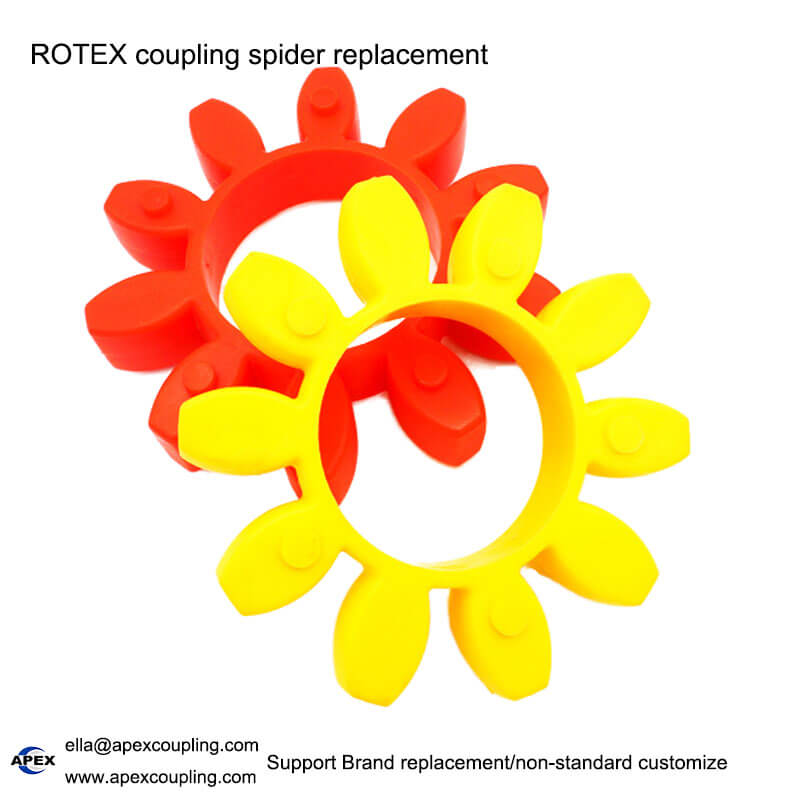
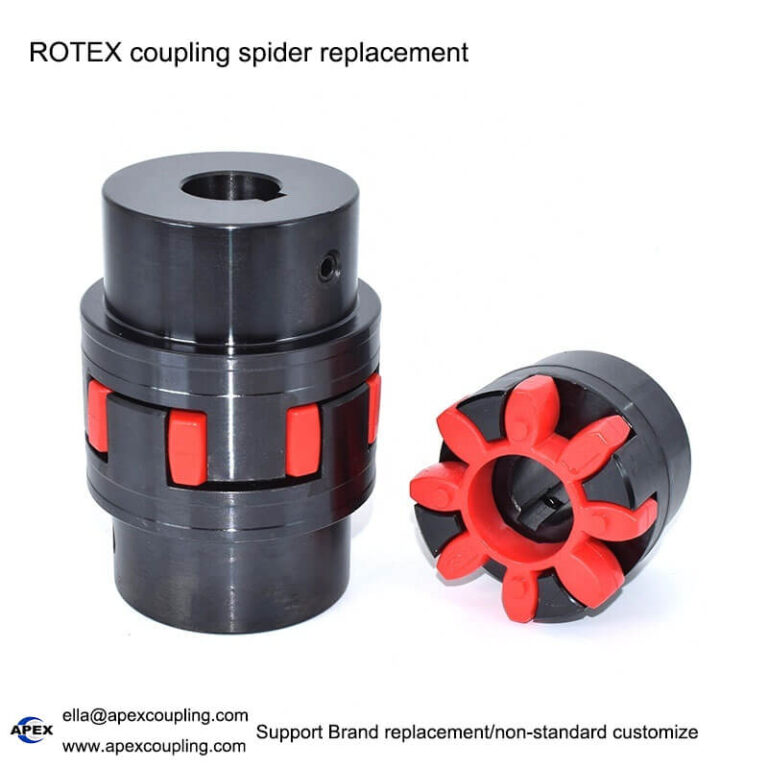
Apex Coupling supplies 98 Shore A polyurethane ROTEX-type coupling spiders for compatible GR jaw coupling applications.
The available range includes multiple sizes from ROTEX 14 to ROTEX 180.
These replacement elastomers are designed for flexible shaft coupling applications requiring torque transmission, vibration damping and elastic connection between coupling hubs.
98 Shore A ROTEX coupling spider
Conclusion
The hardness of a coupling spider has a direct influence on coupling behavior.
A 98 Shore A coupling spider provides a relatively firm polyurethane elastomer solution for compatible jaw coupling applications.
However, hardness should always be evaluated together with torque, speed, misalignment, temperature and operating conditions.
Contact Apex Coupling for 98 Shore A PU coupling spider selection, OEM production and custom GR/ROTEX-type elastomer solutions.
Inquiry now:
ella@apexcoupling.com
steel vs cast iron jaw coupling, rotex spider hardness guide, flexible coupling for motor, elastic coupling maintenance.