Universal joint coupling failure, universal joint coupler damage, universal joint wear, coupling maintenance supplier
Universal Joint Coupling Failure: 4 Common Causes & Solutions Apex Coupling,
- oem coupling
Universal Joint Courier Failure: Top 4 Causes & Prevention Tips
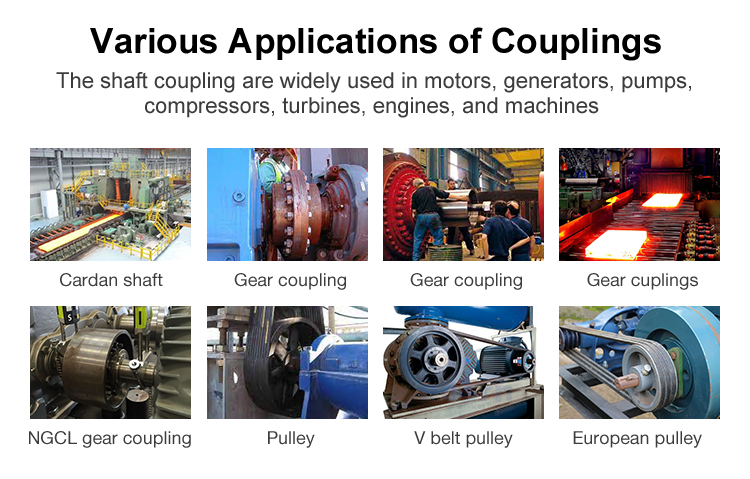
Of course. Flexible couplings are used in a vast range of applications where their primary function is to transmit torque between two shafts while accommodating for misalignment and/or absorbing shock and vibration.
Here is a breakdown of the key applications, categorized by the primary benefit they provide:
1. Applications Requiring Misalignment Compensation
This is the most common reason for using a flexible coupling. Perfect, permanent alignment between two connected shafts (e.g., a motor and a pump) is almost impossible to achieve and maintain.
Pump Systems: The classic application. Connects an electric motor to a pump (centrifugal, positive displacement). Flexible couplings accommodate the inevitable parallel and angular misalignment, protecting both the motor and pump bearings.
Compressors and Fans: Similar to pumps, these are ubiquitous in HVAC systems, industrial plants, and power generation.
Conveyors: Long conveyor systems are prone to settling and misalignment. Flexible couplings connect the drive motor to the conveyor rollers, ensuring smooth operation despite shifting foundations.
Machine Tools: In CNC machines, milling machines, and lathes, couplings connect servomotors to ball screws and lead screws. They accommodate minor misalignments while providing high torsional stiffness for precise positioning.
2. Applications Requiring Vibration Damping and Shock Absorption
Some couplings use elastomeric elements (like polyurethane or rubber “spiders”) to absorb energy.
Crushing and Grinding Equipment: Machinery like crushers, hammer mills, and pulverizers generate severe shock loads. Elastomeric couplings (e.g., Jaw Couplings) absorb these shocks, protecting the drive motor and other components.
Extruders and Injection Molding Machines: The process of pushing plastic or metal through a die creates pulsating loads. Flexible couplings help smooth out the torque transmission.
Marine Propulsion Systems: Couplings are used between the engine and the propeller shaft to dampen torsional vibrations from the engine and the propeller’s interaction with the water.
3. Applications Requiring High-Speed and High-Precision
These applications often use metallic flexible couplings like Bellows or Disc couplings.
Servo Motors: Widely used in robotics, automated assembly, and precision manufacturing. Bellows Couplings and Beam Couplings are popular here because they offer zero backlash, high torsional stiffness, and can accommodate misalignment without introducing significant forces.
Aerospace and Defense: Actuators for flight control surfaces, instrumentation, and gyroscopes use small, precise, and reliable flexible couplings.
Turbomachinery: High-speed equipment like turbines and compressors in power generation and the oil & gas industry use Disc Couplings or Metallic Grid Couplings that can handle high speeds, high temperatures, and precise alignment requirements.
4. Applications with Special Requirements
Food & Beverage and Pharmaceutical: These industries require couplings that are easy to clean and resistant to corrosion and bacterial growth. Stainless Steel Bellows or Disc Couplings are common, often with compliant hygienic (e.g., 3-A) designs.
Chemical Processing: Applications involve exposure to corrosive chemicals, requiring couplings made from special materials like stainless steel or Hastelloy.
Summary Table of Applications
| Application Area | Example Machines | Primary Coupling Function | Typical Coupling Types |
|---|---|---|---|
| General Industry | Pumps, Fans, Compressors, Conveyors | Misalignment Compensation | Jaw, Gear, Grid, Disc |
| Precision Automation | CNC Machines, Robotics, Servo Drives | Precision, Zero Backlash, Misalignment | Bellows, Oldham, Beam, Disc |
| Heavy-Duty & Mining | Crushers, Mixers, Extruders | Shock Load Absorption | Jaw (Elastomeric), Grid |
| High-Speed | Turbines, Centrifuges, High-Speed Spindles | High-Speed Stability, Misalignment | Disc, Bellows |
| Special Environments | Food Processing, Chemical Pumps, Marine | Corrosion Resistance, Hygiene, Vibration Damping | Stainless Steel Bellows/Disc, Marine Couplings |
In short, if you have a motor driving a rotating shaft, and there is any potential for misalignment, vibration, or shock, a flexible coupling is almost certainly a critical component of the system.