
How to Remove a Universal Joint: A Step-by-Step Guide for a Safe Replacement
A worn-out universal joint can cause dangerous vibrations and lead to the failure of your entire universal joint drive shaft. Knowing how to remove and replace it is a valuable skill that can save you from costly downtime and repairs. While the process requires some mechanical confidence, it is very achievable with the right tools and guidance.
This step-by-step tutorial will walk you through how to safely remove a standard universal joint. We’ll also touch on considerations for more complex systems like a double cardan shaft. Remember, for all your power transmission needs, from individual joints to complete assemblies, ApexCoupling is your trusted partner.
Safety First: Essential Precautions
Secure the Vehicle/Machine: Engage the parking brake and chock the wheels. For industrial equipment, ensure all power sources are locked out.
Work on a Stable Surface: Use jack stands to support the vehicle or machinery. Never rely solely on a jack.
Wear Safety Gear: Safety glasses and gloves are mandatory to protect from metal clips and spring tension.
Tools You Will Need
Socket Set and Wrenches
Screwdrivers (Flat-head)
Needle-Nose Pliers
A Vice (highly recommended)
Hammer and Punch (or a dedicated U-Joint Removal Tool/Service Kit)
Step-by-Step Guide to Removing a Universal Joint
Step 1: Remove the Drive Shaft
First, you need to access the universal joint. This involves removing the entire universal joint drive shaft.
Use your socket set to unbolt the flange or yoke at both ends of the drive shaft.
Mark the flanges and the shaft with a paint pen to ensure proper alignment during reinstallation. This is crucial for maintaining balance.
Carefully slide the drive shaft out from the transmission or differential.
Step 2: Secure the Drive Shaft and Identify the Clips
Mount the drive shaft securely in a vice. Place soft jaws or rags between the vice and the shaft to prevent damage.
Locate the retaining clips on the bearing caps of the universal joint. These are typically circular or C-shaped clips that hold the bearing caps in the yoke.
Step 3: Remove the Retaining Clips
This is often the trickiest part.
Use a small flat-head screwdriver or a dedicated clip-removal tool.
Carefully work one end of the clip out of its groove.
Once one end is free, you can usually use needle-nose pliers to twist and remove the entire clip.
Repeat this process for all four bearing caps (two clips per joint).
Step 4: Press Out the Bearing Caps
You now need to push the bearing caps out of the yoke. There are two common methods:
Method A: Using a Vice and Sockets (The Press Method)
This is the preferred, controlled method.
Place a socket (slightly larger than the bearing cap) on one side of the yoke, aligned with the bearing cap.
On the opposite side, use a smaller socket or a deep-well socket that is small enough for the bearing cap to pass through.
Slowly tighten the vice. The bearing cap on the top will be pressed into the smaller socket, pushing the opposite cap out into the larger socket below.
Method B: Using a Hammer and Punch (The Impact Method)
Use this method with caution, as it can damage components if done incorrectly.
Place the yoke over an open-jaw vise or a stable surface with a hole.
Use a brass punch and hammer to tap one bearing cap out. As it moves, it will push the opposite cap out from the other side.
Step 5: Remove the Spider and Remaining Caps
Once one bearing cap is partially out, you can usually pull the spider (the cross) out by hand. The other bearing caps may follow or can be tapped out easily. Be careful—the needle bearings inside the caps can fall out.
Special Note: Removing a Double Cardan Shaft Joint
A double cardan shaft has two universal joints connected by a centering yoke. The removal process is similar, but it often involves a centering ball and socket in the middle yoke. This assembly is more complex. It’s crucial to mark all components for reassembly and pay close attention to the specific orientation of the centering unit. For these intricate systems, consulting the manufacturer’s guide or seeking professional help is often advised.
The Final Step: Install a High-Quality Replacement
Once the old universal joint is out, you can clean the yoke and install a new one by reversing the removal process. The most important factor in a successful repair is the quality of the replacement part.
Your Trusted Source for Universal Joints and Drive Shafts
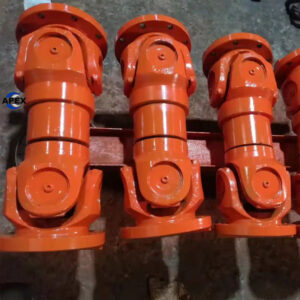
At ApexCoupling, we understand that a reliable universal joint drive shaft is critical to your operation’s uptime. Whether you’re replacing a single universal joint on a piece of industrial equipment or need a fully balanced double cardan shaft for a heavy-duty application, we have you covered.
We offer:
Precision-Engineered Universal Joints for smooth performance and long life.
Complete Universal Joint Drive Shaft Assemblies, ready for installation.
Robust Double Cardan Shafts designed to handle higher angles with minimal vibration.
Don’t compromise on quality. A failed joint can lead to more significant damage.
Ready for a reliable replacement? Browse our extensive catalog of power transmission products at ApexCoupling and find the perfect solution for your needs. Our experts are here to help you keep your machinery running smoothly.