
How Does a Universal Joint Work? A Deep Dive into Flexible Power Transmission
From the drive shafts of heavy-duty trucks to the precise controls of industrial machinery, the universal joint is a cornerstone of mechanical engineering. But how does this ingenious component actually work? If you’ve ever wondered how power is smoothly transmitted between two misaligned shafts, you’re in the right place.
This guide will break down the mechanics of the universal joint in a simple, easy-to-understand manner. We’ll also explore advanced variations like the double cardan shaft and highlight the critical role of the universal joint drive shaft in various applications.
The Basic Anatomy of a Universal Joint
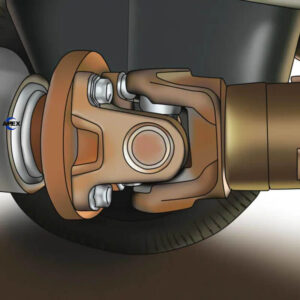
Before we dive into the mechanics, let’s identify the key parts. A typical universal joint (U-joint) consists of four main components:
Yoke (Input): Connected to the driving shaft.
Spider (Cross): The central cross-shaped piece that connects the yokes.
Bearings (Needle Rollers): Placed on each arm of the spider to allow smooth rotation within the yokes.
Yoke (Output): Connected to the driven shaft.
This assembly is also known as a Cardan joint or Hooke’s joint.
The Core Principle: How It Transmits Power and Handles Misalignment
The universal joint’s primary job is to transmit rotational power from one shaft to another when they are not in a straight line. It achieves this through its unique pivoting design.
Imagine holding two screwdrivers, connected by a cross-shaped pivot. You can twist one screwdriver, and the other will turn, even if you bend them at an angle. This is the fundamental principle of a universal joint.
Here’s a step-by-step breakdown of how it works:
Power Input: The driving shaft (input) rotates, turning its attached yoke.
Spider Action: This rotation forces the central spider to rotate. The spider pivots on its bearings within the input yoke.
Power Transfer: As the spider rotates, it pushes against the output yoke, causing it to turn and rotate the driven shaft.
Accommodating Angles: The pivotal connection of the spider allows the two shafts to be at an angle (typically up to 15-30 degrees) while still transmitting torque. The joints can pivot to accommodate this misalignment dynamically.
The One Key Challenge: Non-Uniform Velocity
A crucial characteristic of a single universal joint is that it is not a constant-velocity joint. This means:
If the input shaft rotates at a perfectly constant speed, the output shaft’s speed will oscillate—it speeds up and slows down twice per revolution.
The greater the operating angle between the shafts, the more pronounced this velocity fluctuation becomes.
This can cause vibrations, noise, and wear in the system, which is a significant limitation for some applications.
The Solution: The Double Cardan Shaft
To solve the problem of velocity fluctuation, engineers developed the double cardan shaft. This is essentially two standard universal joints assembled together with a centering yoke, connected by a short intermediate shaft.
The key to its success is that the two joints are phased 90 degrees out of phase with each other. This clever arrangement causes the velocity fluctuations of the first joint to be canceled out by the equal and opposite fluctuations of the second joint. The result is a near-constant velocity output, making the double cardan shaft a superior choice for applications requiring smooth operation at higher angles, such as in 4×4 vehicles and high-performance industrial machinery.
Common Applications of the Universal Joint Drive Shaft
The universal joint drive shaft is a workhorse in many industries. Its ability to handle misalignment and transmit high torque makes it indispensable in:
Automotive: In propeller shafts that send power from the transmission to the rear axle.
Industrial Machinery: In rolling mills, conveyors, and printing presses where precise alignment is difficult to maintain.
Agricultural Equipment: In tractors and combines that require robust and flexible power transmission.
Aerospace and Marine: In control systems and propulsion units.
Find High-Performance Universal Joints and Drive Shafts at ApexCoupling
Understanding how a universal joint works is the first step. The next is choosing a reliable, high-quality component for your application. At ApexCoupling, we specialize in engineering and manufacturing premium power transmission solutions.
Our product range includes:
Robust Universal Joints: Designed for durability and high torque capacity.
Smooth Double Cardan Shafts: For applications demanding constant velocity and minimal vibration.
Custom Universal Joint Drive Shafts: Tailored to your specific length, torque, and misalignment requirements.
A Full Range of Couplings: To complement your driveline system.
We are committed to providing our clients with components that enhance efficiency, reduce downtime, and deliver long-lasting performance.
Ready to power your next project? Browse our catalog of universal joints, double cardan shafts, and drive shafts on our website, or contact our expert team today for a personalized solution!