Elastic Pin Coupling vs Rigid Coupling – A Practical Selection Guide for Heavy‑Duty Drives
Choosing the right coupling can dramatically affect your machine’s reliability, maintenance cost, and downtime. Two common types are elastic pin couplings (e.g., LX nylon pin type) and rigid couplings. This guide compares them head‑to‑head and helps you decide which one fits your heavy‑duty application.
1. Quick Comparison Table
| Feature | Elastic Pin Coupling (LX Nylon Pin) | Rigid Coupling |
|---|---|---|
| Misalignment accommodation | ✅ Yes (eccentricity ≤0.1mm, angle ≤1°) | ❌ No (must be perfectly aligned) |
| Shock absorption | ✅ Yes (nylon pins dampen impact) | ❌ No (transmits all shock) |
| Backlash | Minimal (pin fit) | Zero (if solid) |
| Torque capacity | High (up to 18,000 N·m or more) | Very high |
| Maintenance | Replaceable pins – low downtime | Low, but misalignment causes bearing failure |
| Brake wheel integration | ✅ Available | ❌ Rarely |
| Best for | Long shafts, moderate misalignment, shock loads | Short, precisely aligned shafts |
2. When to Choose an Elastic Pin Coupling (LX Type)
Choose elastic pin coupling if:
Your shafts have some unavoidable misalignment (up to 0.1mm eccentricity or 1° angle)
There are start/stop shocks or torque spikes (e.g., crushers, mixers)
You need vibration damping to protect bearings and gears
You want easy pin replacement without disassembling whole drive train
A brake wheel is required for stopping/emergency brake (hoists, cranes)
Real‑world example: A die‑cutting machine (mask machine) experienced frequent bearing failures with rigid couplings. Switching to LX nylon pin coupling (45# steel, nylon 6 pins) reduced failures by 70% while maintaining torque transmission.
3. When to Stick with a Rigid Coupling
Choose rigid coupling if:
Shafts are short, thick, and perfectly aligned (e.g., servo motor to ball screw)
You need absolute zero backlash for positioning accuracy (CNC, robotics)
No shock loads exist
You cannot tolerate any wind‑up or torsional deflection
⚠️ Warning: Using a rigid coupling in a misaligned system will quickly destroy bearings and cause shaft bending.
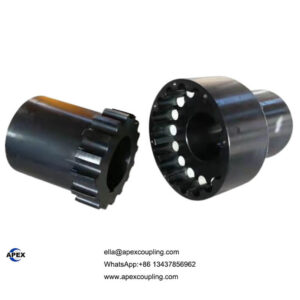
4. Why the LX Nylon Pin Coupling Stands Out for Heavy Duty
Based on our factory data (Apexcoupling), the LX series offers:
High torque capacity – up to 18,000 N·m, suitable for heavy industrial drives
45# steel body + black oxide – strong, wear‑resistant, corrosion‑resistant
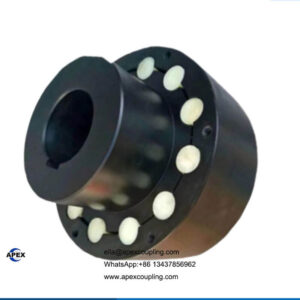
Nylon 6 pins & adjusting ring – elastic enough for misalignment but durable for long life
Brake wheel option – eliminates an extra component, saves space
Multiple models – available for various shaft diameters and power ratings
5. Installation & Maintenance Tips for Elastic Pin Couplings
Check alignment – even though it allows 0.1mm eccentricity, keep it as low as possible to extend pin life.
Inspect nylon pins every 6 months – replace when worn or cracked.
Lubricate – although nylon is self‑lubricating, light grease on gear teeth reduces wear.
Brake wheel surface – keep clean and check for runout periodically.
6. Conclusion
For most heavy‑duty industrial applications where shafts are not perfectly aligned and shock loads are present, an elastic pin coupling (LX nylon pin type) is the smarter choice. It protects your machinery, reduces downtime, and offers the added option of a brake wheel.
If your system demands zero misalignment and zero backlash, go rigid. Otherwise, choose the LX coupling.
👉 Need a custom LX nylon pin coupling with or without brake wheel? Contact Apex Coupling – we offer factory direct pricing and engineering support.
elastic pin coupling vs rigid coupling
nylon pin coupling guide
when to use pin coupling
brake wheel coupling application