
Coupling Solutions: Solving Alignment, Vibration, Shock and Axial Movement Problems
While we pay significant attention to selecting motors and pump equipment, the importance of choosing the right coupling to connect these components is often greatly underestimated. The correct installation and alignment procedures for couplings are frequently overlooked. Improper installation and uncontrolled misalignment can lead to premature coupling wear, potential failures, and possible damage to both pumps and motors.
The fundamental functions of a coupling are to transmit power, accommodate misalignment, and compensate for axial movement. In some cases, couplings can also absorb shock or vibration. Selecting the appropriate coupling depends on four basic conditions of shaft misalignment or movement: parallel misalignment, angular misalignment, axial float, and shock or vibration that typically causes torsional movement.
Elastic coupling solutions can accommodate most inherent system imperfections and conditions. Even with perfectly aligned equipment shafts initially, once operation begins, temperatures change, operating conditions vary, and foundations settle – these changes necessitate not just any coupling, but one that is properly sized and application-appropriate.
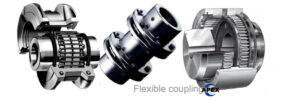
Elastic Coupling and Misalignment Solutions
Through elastic coupling technology, pumps and driving equipment can be connected with slight misalignment. Elastic couplings typically contain one or two flexible elements to accommodate minor misalignments. There are many types of flexible coupling solutions available. However, the allowable deviation of elastic couplings always has limits.
When centrifugal pumps and motors are connected using flexible shaft coupling technology, exceeding alignment limits results in additional loads and vibrations. As coupling manufacturing standards improve, modern couplings can withstand higher misalignment than before. But even within a coupling’s tolerance range, misalignment causes bending deformation of the elastic element with each rotation, eventually leading to coupling fatigue over time. Therefore, reducing misalignment remains beneficial even with high-quality couplings.

Metal Flexible Couplings: High-Speed, High-Torque Applications
While elastic coupling products are commonly used in many general industrial pump applications running up to 115 HP/100 RPM, the limits of elastomeric materials are exceeded in applications requiring higher torque transmission and speeds. Gear couplings, grid couplings, and diaphragm couplings are metal couplings with greater torsional rigidity that offer advantages in these applications.
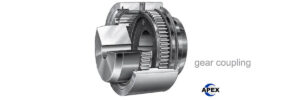
Gear Couplings
Gear couplings consist of a sleeve containing internal teeth that mesh with teeth on the external surface of hubs. They are popular in both high-speed, high-horsepower and high-torque, low-speed applications, performing well where torsional stiffness is required. The meshing of teeth in the coupling allows for misalignment, but the degree of angular misalignment compensation depends on the gear tooth profile and the clearance between them.
Serpentine Spring Couplings
These couplings consist of two flanged hubs with grooves, connected by springs in a grid formation. Like gear couplings, they require lubrication. They offer considerable flexibility and efficiency under high torque at both high and low speeds, with operating speeds up to 400 HP/100 RPM. Due to their greater rigidity, their misalignment capability is not as extensive as elastic coupling options, making motor and pump shaft alignment more critical.
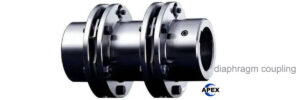
Diaphragm Couplings
Diaphragm couplings are balanced in design, enabling very high-speed rotation, making them ideal for high-RPM pumps. Like elastic coupling products, they require no lubrication. However, diaphragm couplings are relatively sensitive to misalignment and axial movement. Bending of the disc or metal components beyond their yield point can cause fatigue, while extensive axial movement can also lead to failure.
Elastic Couplings: Float, Vibration Isolation, Shock Load Applications
Flexible shaft coupling technology includes three basic types of elastic couplings: tire-type couplings, sleeve-type couplings, and jaw-type couplings. Tire-type and sleeve-type couplings operate in shear (rather than compression) to absorb shock and protect equipment.

Tire-Type Couplings
The energy generated during shock loads is essentially absorbed by the elastomer in the twisting action. One of the greatest advantages of tire-type and sleeve-type elastic coupling solutions: they fail under excessive shock loads and disconnect the pump from the motor in case of any excessive impact, thereby protecting the pump. Tire shaft coupling products are commonly used in continuously operating ANSI pumps where minimal vibration is required.
Sleeve-Type Couplings
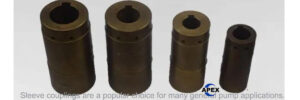
Sleeve couplings are ideal for many general-purpose pumps. These torsionally flexible shaft coupling solutions are perfect for medium misalignment applications. Typical sleeve coupling applications include deep well pumps, vertical end-suction pumps, and vertical turbine pumps.
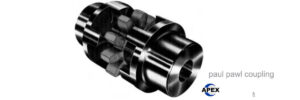
Jaw Couplings
Jaw couplings transmit torque by compressing the elastic element being squeezed rather than twisting, so they don’t have the same misalignment capability or axial and torsional damping capacity as the two elastic coupling types mentioned above. Jaw couplings are typically used in low-power applications where cost is the primary selection criterion.
Coupling Selection Considerations
Through coupling selection, pump users need to be aware of the “more is better” trap:
Oversized couplings can result in reduced flexibility or compensation for misalignment, and excessively large couplings impose additional stress on the coupled pump and motor.
Couplings with too much misalignment tolerance capability may be too soft or “compliant,” potentially causing vibration or rotational imbalance.
When selecting the proper elastic coupling, it’s important to examine the environment in which the pump/motor will operate, including exposure to extreme temperature changes.
Custom Coupling Solutions from ApexCoupling Factory
At ApexCoupling, we understand that every application has unique requirements. As a professional coupling factory, we offer:
Custom coupling solutions tailored to specific operational needs
Comprehensive range of flexible shaft coupling types including cardan shaft and cardan universal joint products
Technical expertise in selecting between rigid coupling and flexible coupling options
Spider coupling solutions for various industrial applications
Our engineering team can help you navigate the complexities of coupling selection to ensure optimal performance and longevity for your equipment.
Need expert guidance on coupling solutions?
Contact ApexCoupling today for professional assistance in selecting the right elastic coupling, flexible shaft coupler, or custom coupling solution for your specific alignment, vibration, shock, and axial movement challenges.