Engineering Guide: Benefits of Detachable Universal Joints in Construction Machinery
In heavy machinery, construction equipment, and production automation, transmitting power between non-coaxial shafts requires flexible cardan joints that can withstand angular misalignment and high rotational torque. However, servicing conventional universal joints often requires disassembling large segments of connected equipment, causing extended downtime.
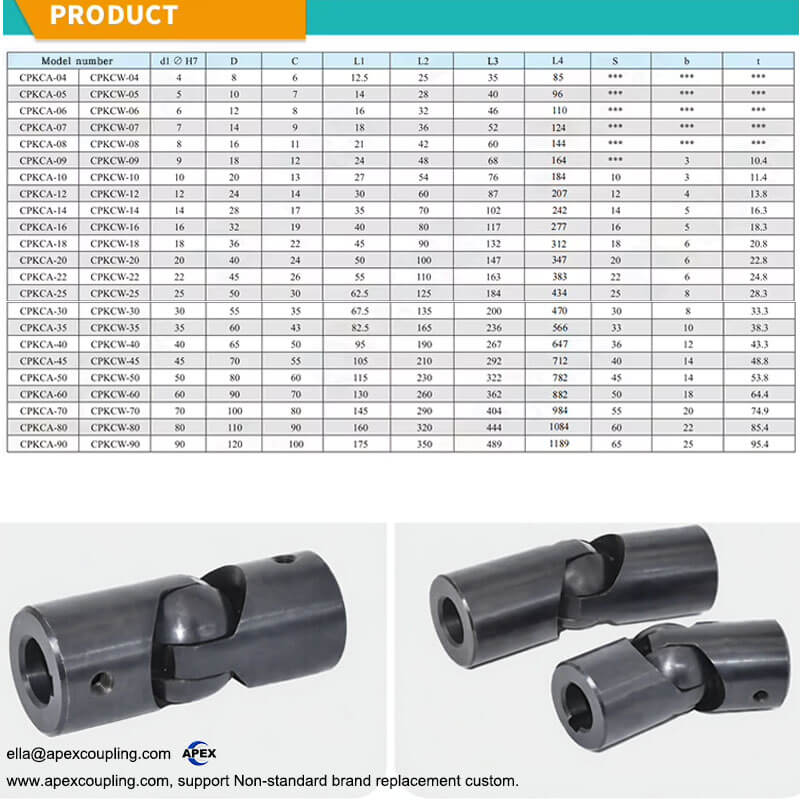
The CPKCA and CPKCW series detachable universal joints solve this issue by offering a modular design that allows for fast installation and removal. In this guide, Apex Coupling explains the key structural advantages of detachable cardan joints and how to specify them for industrial drive systems.
1. What Is a Detachable Universal Joint and How Does It Work?
A detachable universal joint consists of high-strength yoke hubs connected through a removable pin and cross block assembly.
Unlike solid welded or fixed-pin joints, the detachable structure allows engineers to unbolt or release central joint components without removing connected drive motors, gearboxes, or driven shafts.
CPKCA Series (Single Joint): Accommodates dynamic angular offset up to 45° between intersecting shafts.
CPKCW Series (Double Joint): Features two joints joined by a short center yoke, accommodating parallel shaft offset and total angular misalignment up to 90°.
2. Key Engineering Advantages of 42CrMo Alloy Steel Construction
When specifying a detachable universal joint for high-load applications, material selection is critical:
A. Forged 42CrMo Steel Body
Heat-treated 42CrMo alloy steel provides high tensile strength and fatigue resistance compared to standard carbon steels, preventing joint yielding under peak starting torques.
B. Precision H7 Bore Options
Machined bore tolerances conform strictly to H7 standards, preventing rotational wobble and keyway wear. Custom options include smooth bores, keyways, square holes, and hexagonal bores.
C. High Transmission Efficiency
Precise bearing surfaces ensure minimal mechanical friction, maintaining continuous torque transfer efficiency even at extreme operating angles.
3. Selection Tips: Matching CPKCA and CPKCW Models to Your Application
To ensure correct fitment during machine design, evaluate these three parameters:
Shaft Angle & Offset: Use single joints (CPKCA) for simple angular intersections up to 45°. Choose double joints (CPKCW) for wider angles up to 90° or offset parallel shafts.
Torque & Speed Demands: Match your motor power to model sizes ranging from small CPKCA-04 up to heavy-duty CPKCA-90.
Environmental Exposure: Specify protective black oxide or custom surface treatments when operating in moisture-heavy construction or mining environments.
4. Why Partner with Apex Coupling for Detachable Joints?
As a direct factory manufacturer of power transmission components, Apex Coupling provides wholesale solutions for equipment OEMs and industrial distributors:
Direct Factory Supply: ISO9001 and BV certified production located in Guangdong, China.
Full Size Availability: Complete range of standard metric models (CPKCA/CPKCW 04 to 90) maintained in stock.
OEM Customization: Custom shaft bore sizes, special overall lengths, and tailored CAD drawings supplied upon request.
Summary & Inquiry
Upgrading to detachable universal joints optimizes torque transmission across misaligned shafts while dramatically reducing equipment servicing time.
Contact the technical support team at Apex Coupling today for dimensional CAD drawings or direct factory quotes!
Website: www.apexcoupling.com
Email: sales@apexcoupling.com
Explore Products: View CPKCA / CPKCW Detachable Universal Joint Product Page
Inquiry now:
ella@apexcoupling.com
CPKCA universal joint guide, CPKCW double joint selection, quick disassembly cardan shaft, 42CrMo joint maintenance