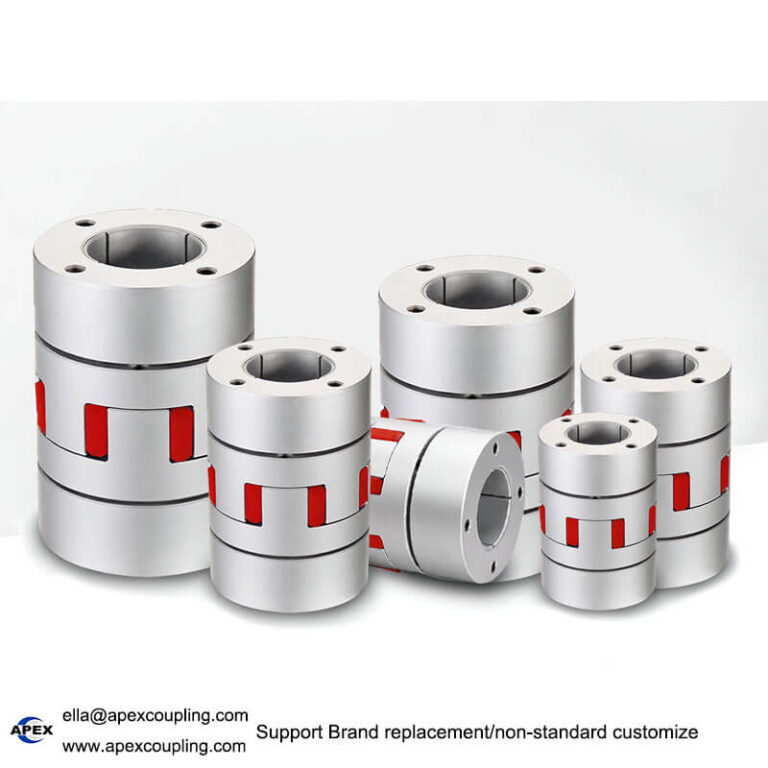
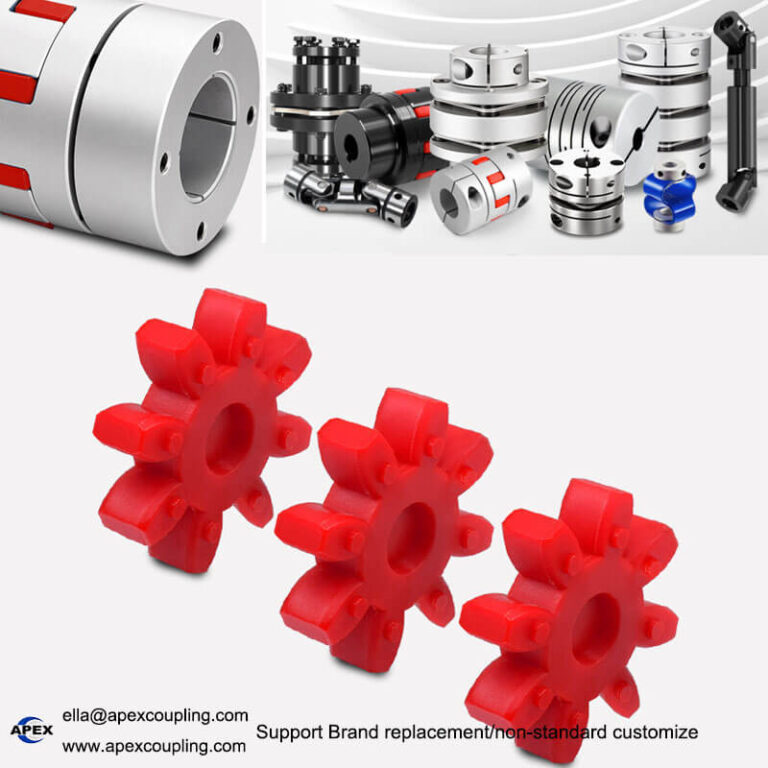
The new standard LM-type plum blossom coupling, formerly known as the ML-type plum blossom coupling, has the following specifications and dimensions table.
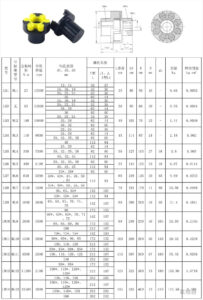
The plum blossom coupling mainly consists of two half-couplings and a plum blossom-shaped elastic element. Based on its structure, it is classified into LM type (basic type), LMD type (single-flange type), LMS type (double-flange type), LMZ type (with brake wheel type), and others. The differences in dimensions among the various types are mainly reflected in the flange design and brake wheel configuration. For example:
LM type: No flange, directly connecting two shafts through the elastic element. It is compact in size and suitable for applications with limited space.
LMD type: Single-sided flange, facilitating installation and positioning. Its outer diameter is slightly larger than that of the LM type.
LMZ type: Integrated brake wheel, with a significantly larger outer diameter (e.g., the brake wheel diameter of the LMZ12-Ⅱ type can reach 630mm). It is suitable for equipment requiring braking functionality.
Key Specifications:
Bore Diameter Range: A single model can accommodate multiple shaft diameters (e.g., LM3 supports 20–38 mm). The appropriate specification must be selected based on the actual shaft diameter.
Bore Length: Available in Y-type (cylindrical) and J1/Z-type (tapered). It is recommended to prioritize the recommended length L_recommended. Non-standard lengths must be confirmed with the manufacturer.
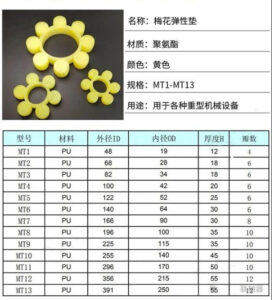
Elastomer Model: MT1–MT13 correspond to plum blossom elastomers of different hardness levels and dimensions (e.g., MT3 elastomer has 6 lobes with a hardness ≥75 HA). The elastomer model must match the coupling model.
Mass and Moment of Inertia: Approximate values are calculated based on the minimum bore diameter. Actual values may vary depending on bore size and material adjustments.