
45 Steel vs 40Cr vs 42CrMo: What’s the Difference and How to Choose?
In mechanical design, equipment manufacturing, transmission systems, and custom automation industries, 45 steel, 40Cr, and 42CrMo are three of the most commonly used structural steels. While they may appear similar at first glance, their chemical compositions, mechanical properties, heat treatment responses, and application scenarios differ significantly. Choosing the wrong material can lead to reduced service life at best, and complete failure at worst. This article systematically breaks down the differences between these materials from an engineering perspective and provides practical guidance for selection.
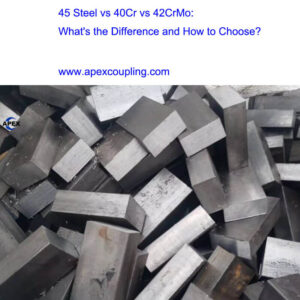
Chemical Composition Differences: The Foundation of Material Properties
45 steel is a typical medium-carbon steel, primarily composed of carbon with almost no significant alloy elements. 40Cr adds approximately 1% chromium, significantly improving strength, hardenability, and wear resistance. 42CrMo further enhances the composition by adding molybdenum to 40Cr, improving hardenability, toughness, and impact resistance, while maintaining good hardening depth even in large cross-section components.
In summary: 45 steel is the “basic type,” 40Cr is the “enhanced type,” and 42CrMo is the “high-strength, high-toughness type.”
Mechanical Properties: Which is Stronger?
Under the same heat treatment conditions, the strength grades of these three materials show a clear progression:
45 steel has the most ordinary strength, suitable only for medium or general loads. 40Cr demonstrates significantly better strength and toughness than 45 steel, making it the “versatile alloy steel” in the machinery industry. 42CrMo possesses higher strength, better impact toughness, and superior fatigue life, making it the primary material for high-stress critical structural components.
Simply put: use 45 steel for low strength requirements, 40Cr for medium strength, and 42CrMo for high strength and reliability requirements.
Heat Treatment Performance: Response to Thermal Processing
45 steel has poor hardenability – thick cross-sections struggle to achieve complete hardening at the core, making it suitable only for smaller shafts, pins, and sleeves. 40Cr shows significantly better hardenability than 45 steel, allowing quenching and tempering of medium-cross-section components with stable performance. 42CrMo has the best hardenability among the three, enabling uniform hardness and strength even in large-sized workpieces, making it extremely common for large shaft types and heavy-duty impact components.
If you need heat treatment to enhance performance, the ranking is simple: 42CrMo is best, followed by 40Cr, with 45 steel being the most ordinary.
Engineering Applications: Respective Positions and Suitable Scenarios
45 steel is mostly used for general mechanical components such as small transmission shafts, pins, sleeves, general gears, and crankshafts. Its advantages lie in low cost and good machinability. 40Cr is commonly used for shafts, gears, connecting pieces, and mold components bearing medium loads – it’s the most common “all-rounder” in the machinery industry. 42CrMo is used for heavy loads, high impact, high fatigue life, and critical safety components, such as large transmission shafts, engineering machinery structural components, important bolts, crankshafts, hydraulic components, and important load-bearing components in automotive and aerospace applications.
In one sentence: 45 steel for general components, 40Cr for medium-load components, and 42CrMo for critical and heavy-duty components.
Material Selection Guide for Designers
First, consider load requirements. General loads: choose 45 steel; Medium loads and conventional industrial components: choose 40Cr; Applications with impact, fatigue, and heavy-duty tasks: must use 42CrMo.
Second, consider cross-section size and hardenability. Small components: 45 steel is usually sufficient; Medium sizes: 40Cr is safer; Very large cross-sections or requirements for uniform hardness throughout: only 42CrMo will work.
Third, consider whether surface hardening is needed. For carburizing, typically choose 20Cr, 20CrMnTi, and other carburizing steels; For overall quenching and tempering, prioritize 40Cr or 42CrMo.
Fourth, consider cost and machinability. 45 steel is the cheapest with the best machinability; 40Cr and 42CrMo costs increase progressively with slightly higher processing difficulty; For batch production and cost-sensitive enterprises, if strength requirements permit, there’s a tendency to choose 40Cr instead of 42CrMo.
Material Selection in Power Transmission Components
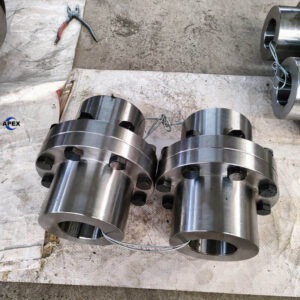
The choice of material becomes particularly crucial in power transmission applications. For flexible coupling applications, different materials suit different operating conditions:
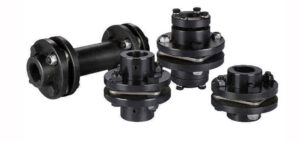
Spider couplings for general applications may use 45 steel
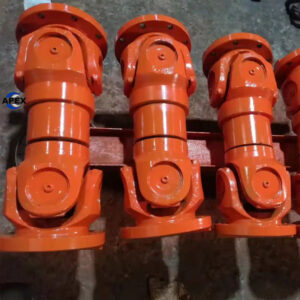
Cardan shaft components for medium loads typically utilize 40Cr
Heavy-duty cardan universal joint systems and critical flexible shaft coupling applications often require 42CrMo
When comparing flexible shaft coupling types, material selection directly impacts performance and longevity. While tire shaft coupling elements use different materials, their metal components still follow the same material selection principles.
ApexCoupling’s Material Expertise
At ApexCoupling, we understand that material selection is fundamental to product performance. Our engineering team carefully selects materials based on application requirements:
Standard flexible coupling components: Optimized material selection for cost and performance
Cardan shaft systems: Appropriate alloy steels for specific torque and load requirements
Critical cardan universal joint applications: Premium materials for maximum reliability
We offer various flexible shaft coupling types with material options tailored to your specific operating conditions, ensuring optimal performance and service life.
Summary: Three Sentences to Help You Remember
45 steel: Low cost, suitable for general load small components, limited heat treatment capability.
40Cr: Good comprehensive performance, suitable for medium loads, the most commonly used alloy steel in conventional machinery industry.
42CrMo: High strength, good hardenability, strong toughness – the high-end material for large critical structural components.
Need help selecting the right material for your coupling application?
Contact ApexCoupling’s engineering team for expert guidance on material selection for cardan shafts, flexible couplings, and other power transmission components. We’ll help you choose the optimal solution for your specific requirements.