Jaw Coupling vs Gear Coupling – Which Flexible Coupling Is Right for Your Pump?
Jaw Coupling vs Gear Coupling – Which Flexible Coupling Is Right for Your Pump?
When selecting a coupling for industrial pumps, construction machinery, or mining equipment, two popular options are jaw flexible couplings (spider/rotex type) and gear couplings. Both have their strengths, but jaw couplings offer distinct advantages in vibration damping, maintenance, and cost. This guide helps you choose the right one.
1. Quick Comparison: Jaw Coupling vs Gear Coupling
| Feature | Jaw Flexible Coupling (Steel, Curved Jaw) | Gear Coupling |
|---|---|---|
| Vibration damping | ✅ Excellent (elastomeric spider) | ❌ Poor (metal‑to‑metal) |
| Shock absorption | ✅ Yes | ❌ Limited |
| Misalignment capacity | Moderate (angular, parallel, axial) | High |
| Maintenance | Simple – replace spider only | Complex – requires lubrication, seal checks |
| Cost | Lower | Higher |
| Weight | Lighter | Heavier |
| Torque density | Good | Higher |
| Backlash | Low | Very low |
| Best for | Pumps, fans, general industrial drives | Heavy mills, rolling mills, high torque |
2. Why Jaw Flexible Couplings Excel in Pump Applications
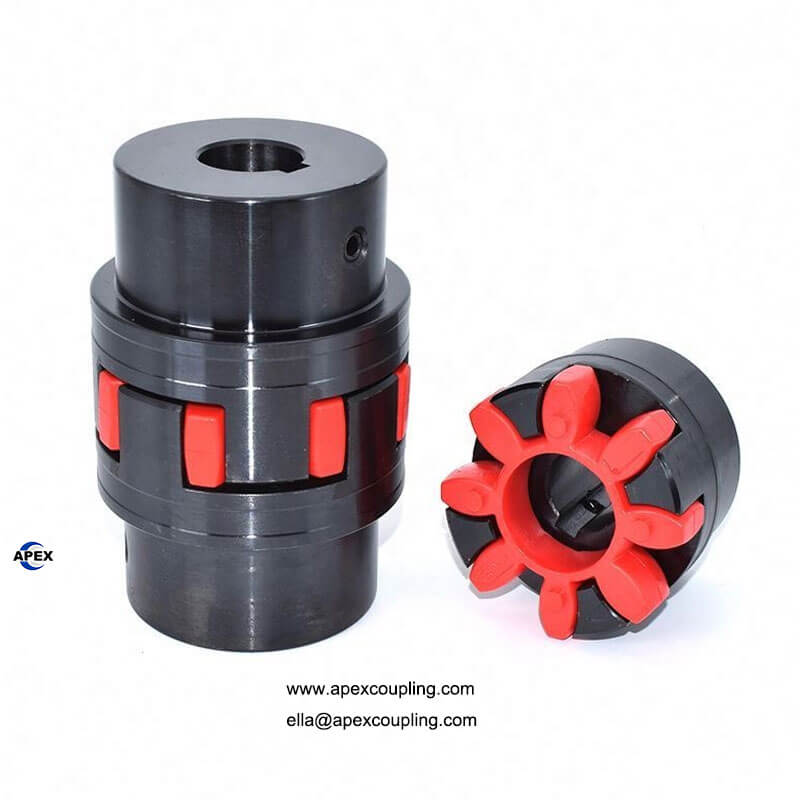
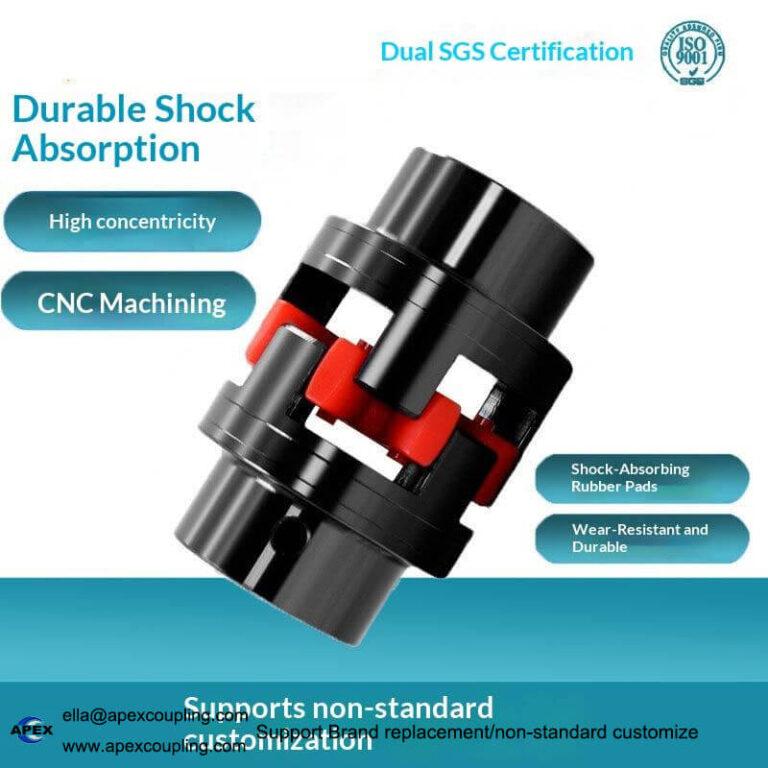
Pumps often experience start/stop shocks, cavitation vibration, and slight misalignment. A jaw coupling with a curved steel hub and elastomeric spider:
Absorbs torsional vibration – protects pump seals and bearings
Reduces noise – quieter operation compared to gear couplings
Extends equipment life – dampens shock loads from the motor
💡 Tip: For pump drives, always choose a coupling with a curved jaw profile – it distributes load evenly over the spider, reducing wear.
3. Steel vs Aluminum Hubs – Why Steel Wins for Heavy Duty
Many standard jaw couplings use aluminum hubs to save cost, but 45# steel offers:
Higher torque capacity – up to 2000 N·m or more
Better wear resistance – especially under frequent start/stop
Greater durability – handles harsh environments (construction, mining)
For industrial applications where downtime is expensive, the extra cost of steel hubs pays back quickly in reliability.
4. Spider Material Selection – What You Need to Know
The elastomeric spider is the heart of a jaw coupling. Choose based on your environment:
| Spider Material | Features | Best For |
|---|---|---|
| Standard Polyurethane | Oil‑resistant, wear‑resistant, good damping | General industrial, pumps, conveyors |
| High‑Temperature | Withstands up to 120°C+ | Furnaces, hot environments |
| Food‑Grade (FDA) | Non‑toxic, easy to clean | Food & beverage processing |
| Low‑Backlash | Harder durometer, precise positioning | Servo drives, indexing applications |
5. Maintenance Tips for Jaw Flexible Couplings
One of the biggest advantages of jaw couplings is easy maintenance – you can replace the spider without moving the motor or driven equipment.
Checklist:
Inspect spider every 6–12 months – look for cracks, wear, or deformation.
Check alignment – even though it accommodates misalignment, keep it within recommended limits to maximize spider life.
Lubrication – generally dry, but light grease on the bore/keyway prevents fretting.
Torque bolts – ensure hub fasteners are tightened to spec (12.9 grade recommended).
6. Real‑World Example – Construction Pump Upgrade
A construction company was using gear couplings on high‑pressure water pumps. Frequent issues:
Seal failures due to vibration transmission
Lubrication leaks from gear coupling housings
Downtime of 4 hours per maintenance
They switched to Apex Coupling steel curved jaw couplings (GE55, 45# steel, black oxide, premium spider) . Results:
Vibration reduced by 60% – pump seal life doubled
Maintenance dropped to 30 minutes – replace spider only
No lubrication required – eliminated leak points
Annual cost savings of over $2,500 per pump
7. When to Choose a Jaw Coupling (And When Not To)
| Choose Jaw Coupling If… | Choose Gear Coupling If… |
|---|---|
| Vibration damping is critical | Space is extremely tight |
| Easy maintenance is a priority | Very high torque density is needed |
| Budget is a concern | Misalignment is severe (>1°) |
| Operating speed is moderate | Operating speed is very high (>6000 rpm) |
| You want simple spare parts (spiders) | You have existing lubrication infrastructure |
8. GE Series – Standard Sizes & Application Mapping
Our GE19–GE90 series covers most industrial needs:
| Model | Approx. Torque Range | Typical Application |
|---|---|---|
| GE19–GE28 | Up to 100 N·m | Small pumps, fans, mixers |
| GE38–GE48 | 100 – 800 N·m | Medium pumps, compressors |
| GE55–GE75 | 800 – 2000 N·m | Large pumps, crushers, conveyors |
| GE90 | 2000+ N·m | Heavy mining, steel mills |
9. Conclusion
For most pump, construction, and mining applications, a steel‑hub curved jaw flexible coupling (Rotex/spider type) offers the best balance of performance, maintenance, and cost. With 45# steel hubs, black oxide finish, and a replaceable elastomeric spider, it delivers reliable power transmission with minimal downtime.
👉 Need a jaw coupling for your next project? Send us your shaft sizes and torque – we will match you with the perfect GE series model.
Inquiry now:
ella@apexcoupling.com
jaw coupling vs gear coupling
flexible coupling for pumps
spider coupling selection
steel jaw coupling advantages
rotex coupling guide
curved jaw coupling benefits